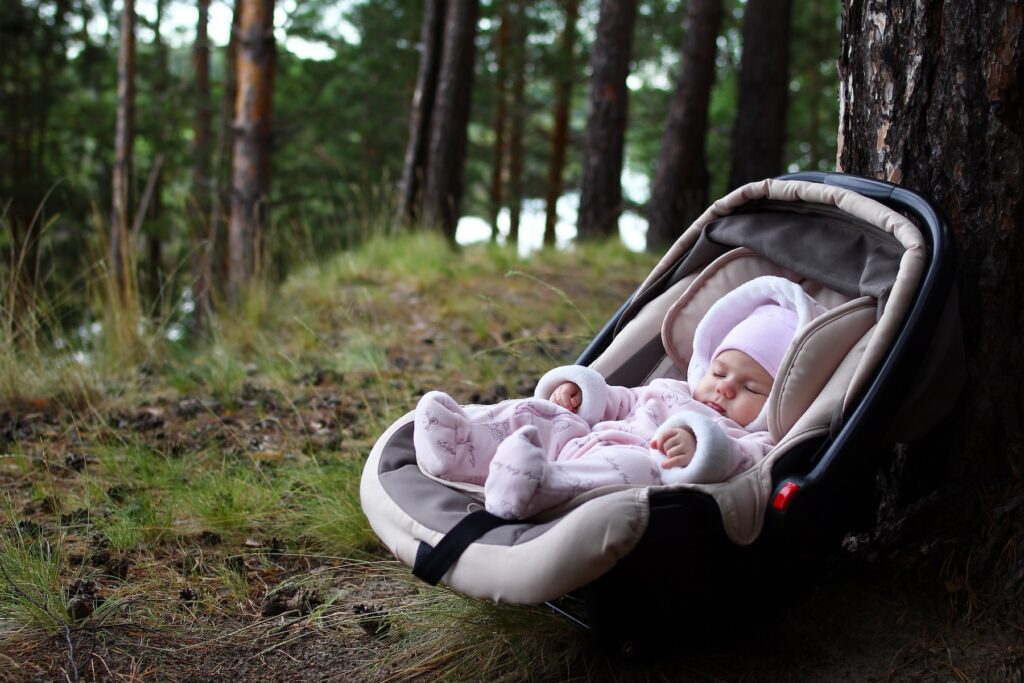
If a baby spends a lot of time with pressure on the same part of their head, that can contribute to flattening. This is one reason parents are often encouraged to give their baby tummy time, vary positions, and avoid too much time in car seats, swings, bouncers, and other containers.
But there is another reason flat surfaces matter.
It is not just about the shape of your baby’s head. It is also about the small movements your baby makes when their body is not being molded by a device.
The American Academy of Pediatrics recommends that babies sleep on their backs on a firm, flat, non-inclined surface, such as a crib, bassinet, or portable play yard with a fitted sheet. They also recommend avoiding routine sleep in seating devices like swings and car safety seats, except while riding in the car.
That recommendation is primarily about safety.
But as a pediatric physical therapist, I also think about it from a movement perspective.
Here’s what’s going on:
A flat surface gives your baby’s body more reason to make little adjustments. A container gives your baby’s body more reason to relax into the shape of the device.
That may sound like a small difference, but for a baby, small movements matter.
Containers quiet your baby’s body
A container is anything that holds your baby in place.
Car seats, swings, bouncers, strollers, infant seats, and similar devices all do this in different ways. They support your baby’s body. They often curve around your baby. They may keep the hips, trunk, shoulders, and head in a fairly fixed position.
That support can be useful. It can keep your baby safe while you do something necessary. It can give you a needed break.
But the same support that makes a container useful also changes what your baby’s body has to do.
When your baby is held by a device, the device does some of the work for them.
Their trunk does not have to adjust as much. Their head may settle into one spot. Their shoulders and hips may be held in a certain position. Their body has less reason to make the tiny adjustments that happen when a baby is resting on a flatter, more open surface.
A container does not just contain your baby. It shapes your baby’s body and reduces their need to respond.
Think about a big bear hug
Imagine someone gives you a big bear hug.
At first, you may wiggle a little. But if the hug is firm enough, your body eventually gives in. You stop trying to move as much. You relax into the pressure because there is not much else to do.
A baby container can work in a similar way.
The seat curves around the baby. The straps hold them in. The padding supports them. The baby’s body settles into the shape of the device.
It is different from resting on a flat surface.
On a flat surface, the baby’s body is not being hugged into one shape. There is more room for small shifts. The baby may turn their head a little. They may adjust their shoulders. They may move their arms or legs. They may subtly change how their trunk rests against the surface.
Babies move even when they are resting
When we think about baby movement, we usually think about the obvious milestones.
Rolling. Sitting. Crawling. Pulling to stand. Walking.
But babies are also developing through tiny movements that are easy to miss.
A baby lying on a flat surface makes small adjustments with their head, neck, shoulders, trunk, arms, and legs. Even when resting, their body is still receiving information from the surface underneath them.
These little movements help a baby get to know their body better. It makes bigger movements possible.
A container reduces these movements.
In a car seat, swing, or bouncer, the device gives the body more external support. The baby does not have to respond as much to gravity, the floor, or their own position. The device holds them in a more fixed shape.
That does not mean every moment in a container is harmful.
It means containers should be used sparingly.
Flat surfaces ask more from your baby’s body
A flat surface does something very helpful: it gives your baby’s body a more neutral place to rest and adjust.
When your baby lies on a firm, flat surface, their body has more freedom. Their head is not tucked into the same curved seat. Their trunk is not molded into the same shape. Their shoulders and hips have more room to settle naturally.
This allows for small, natural movements. Your baby may not look like they are doing much. But their body is still working in quiet ways.
This is one reason I like babies to have plenty of time outside of containers.
They need time to respond to the world instead of being shaped by the device.
Why this matters during sleep
Most parents think about container time when their baby is awake.
That makes sense. Awake time is when we think about tummy time, reaching, rolling, kicking, and playing.
But sleep position matters too.
Even when your baby is asleep, their body is still responding to its environment. That surface they are on is either giving them room to settle naturally, or it is molding them into a specific position.
A car seat, swing, or bouncer often places a baby in a curved or semi-reclined position. The head may fall to one side. The trunk may stay rounded. The shoulders may stay forward. The hips may stay flexed.
A flat sleep surface gives the baby’s body a different experience.
It does not wrap around them in the same way. It does not hold them in the same curve. It gives their body more room to make small adjustments.
That is the part many parents do not think about.
Sleeping in containers is not only about head shape.
It is about how much the container conforms to the baby’s body and how much movement that conformity discourages.
What about babies who sleep better in containers?
Many babies seem to sleep better in a car seat, swing, or bouncer.
They may settle faster. They may like the snugness. They may like the incline. They may like the motion. They may feel held.
A container can feel calming for the same reason a bear hug can feel calming. It gives support. It reduces freedom. It quiets the body.
It’s okay if a baby falls asleep in a container from time to time, but it is best if we can move them to a flat surface to finish their nap.
Car seats are for the car
Car seats are essential.
Use them every time your baby is in the car. A properly used car seat is one of the most important safety tools you own.
But car seats are designed for travel. They are not designed to be your baby’s regular bed.
This distinction helps parents avoid unnecessary confusion.
If your baby falls asleep while you are driving, that is normal. You do not need to panic.
But once you are home or at your destination, the better habit is to transfer your baby to a flat sleep surface when it is safe and practical to do so.
The American Academy of Pediatrics’ parent guidance says that if a baby falls asleep in a car seat, stroller, swing, infant carrier, or sling, they should be moved to a firm sleep surface on their back as soon as possible.
That does not mean you need to panic over every car nap.
But it does give you a good default habit:
Car seat for travel.
Flat surface for sleep.
Where head shape fits into this
If a baby spends a lot of time with pressure on the same part of their head, they can develop flattening on one side or the back of the head. If they often rest with their head turned one way, they may also develop a preference for that direction. This can lead to developmental problems down the road.
Containers can contribute to this because they reduce variety and make it easier for your baby to settle into one preferred spot.
A flat surface gives your baby more variety of positions and an easier time changing to a different position. These factors make it less likely that your baby’s head will develop a flat spot.
Practical takeaway
Containers are useful because they support your baby. But that support is also the reason they should not become your baby’s main resting place.
A container holds your baby in one shape. A flat surface gives your baby more room to make small adjustments.
Those little movements may not look impressive, but they matter.
They help your baby experience their body, shift position, turn the head, settle differently, and avoid being molded into the same posture over and over again.
FAQ
Is it okay if my baby falls asleep in the car seat?
It is common for babies to fall asleep in the car seat while riding in the car. The car seat should always be used for travel. But once you are out of the car, it is best to move your baby to a firm, flat sleep surface on their back as soon as it is safe and practical.

Dr. Trevor E. Carlson, PT, DPT
Pediatric physical therapist, author of Tummy Time to Walking, and founder of InfantPT.com.
I help parents better understand their baby’s movement and development with practical, calm, experience-based guidance.