Sometimes a small movement detail tells you a lot about how a baby is learning to use their body.
This week, I worked with two babies who reminded me how often babies pull when they would benefit from learning to push. It sounds like a small difference, but it can change how they crawl, climb, stand, and eventually walk.
Here’s what’s going on: when babies pull with straight legs, they often rely on the muscles behind their thighs instead of learning to push through bent hips and knees.
That may not sound like a big deal, but pushing helps babies build strength, balance, and control.
The baby who scooted on her bottom
One little girl I worked with scooted on her bottom instead of crawling.
Bottom scooting can be very effective. Babies who do it often get around quickly, keep their hands free, and look very clever doing it. But when a baby scoots instead of crawling, they may miss some of the strengthening and coordination that comes from being on hands and knees.
To help this baby change her movement, we used a cushion from a Nugget play couch as a low obstacle.
At first, she tried to climb onto it from a sitting position. She put both feet on the cushion and pulled with her legs. Her legs stayed fairly straight, and she was trying to drag herself forward instead of getting onto her knees and climbing up.
Once she figured out this wasn’t going to work, she opened herself up to different ideas. Her mom and I were able to help her get onto her hands and knees, and she climbed right up.
Ah, the power of a small obstacle to help change a child’s movement pattern.
The baby who climbed onto the couch
Another baby I saw was standing but not yet walking.
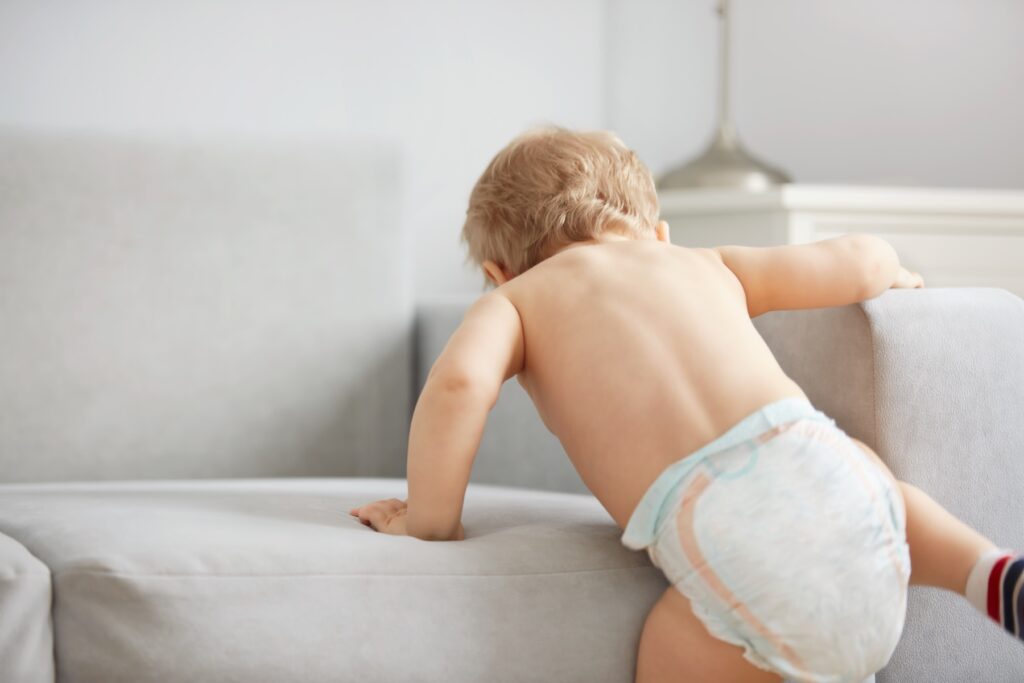
He loved climbing onto the couch. His strategy was to put one foot up on the couch and pull himself up with his knee almost straight.
To help him change this pattern, I gently bent his knee and held it against the couch. This made it easier for him to push through. Sure enough, he started pushing his knee into the couch to climb up instead of using his leg to pull himself up.
Why pushing matters
Pulling is not bad. Babies need to pull too.
They pull to stand. They pull toys toward themselves. They pull on furniture, people, blankets, and anything else they can reach.
The issue is when pulling becomes the main strategy and pushing does not develop well alongside it.
When babies primarily pull with their legs, they may overuse their hamstrings, the muscles on the back of the thigh. They may avoid using their glutes, hips, and trunk muscles as much as they could.
Pushing through bent knees and hips helps babies build a stronger foundation.
It helps with:
- Getting onto hands and knees
- Crawling over obstacles
- Climbing safely
- Moving from the floor to standing
- Squatting
- Walking with better control
Pushing also teaches the body how to organize movement from the ground up.
When a baby bends a knee, puts weight through the foot or leg, and pushes, they are learning how to use strength and balance together. That pattern matters far beyond one single milestone.
What to watch for
You may notice this pattern if your baby:
- Scoots on their bottom instead of crawling
- Has trouble getting into hands and knees
- Climbs by pulling with a nearly straight knee
- Seems strong but uses awkward or effortful movement strategies
This does not mean something is automatically wrong.
Babies experiment. They problem-solve. They use the easiest path available to them.
But if your baby avoids pushing, it may be worth giving them more opportunities to practice.
What you can try at home
You do not need fancy equipment.
A couch cushion, your leg, a firm pillow, or a low step can all give your baby a chance to practice pushing.
The goal is not to make the obstacle too hard. The goal is to make it just challenging enough that your baby has to shift weight, bend a knee, and push.
You can gently help by:
- Encouraging hands-and-knees play
- Placing toys on a 6-12″ step and have them kneel as they play
- Supporting your baby’s knee so they can push through it when climbing
- Letting your baby work through obstacles instead of lifting them over the obstacle
The most important idea is this:
Help your baby push from a bent knee and hip instead of pulling with a straight or nearly straight knee.
You are not trying to correct every movement. You are helping your baby discover a different, helpful pattern.
When to get help
If your baby strongly resists hands-and-knees play, always scoots instead of crawling, seems unusually stiff, uses one side more than the other, or has trouble progressing toward crawling and walking, it check in with your baby’s physical or pediatric physical therapist.
A good therapist can help you understand whether your baby just has a preferred movement habit or whether there is a bigger reason they are avoiding certain positions.
Either way, the goal is not to make you worry.
The goal is to help your baby build more options.
FAQ
Is bottom scooting always a problem?
No. Some babies bottom scoot, grow out of it, and no one would ever know the difference.
Bottom scooting can be a sign that a baby is avoiding hands-and-knees movement, pushing through bent legs, or using both sides of the body together in a balanced way.
If your baby bottom scoots but is also able to crawl, climb, get into hands and knees, pull to stand, squat, and move in a variety of ways, it may not be a concern.
If bottom scooting is their only way of getting around, you see differences between how they use their right and left sides, or they seem stuck in that pattern, check in with a professional.
Pushing is one of those small movement skills that can make a big difference.
When your baby learns to push through bent knees and hips, they are building strength, coordination, and confidence for the next stage of movement.

Dr. Trevor E. Carlson, PT, DPT
Pediatric physical therapist, author of Tummy Time to Walking, and founder of InfantPT.com.
I help parents better understand their baby’s movement and development with practical, calm, experience-based guidance.