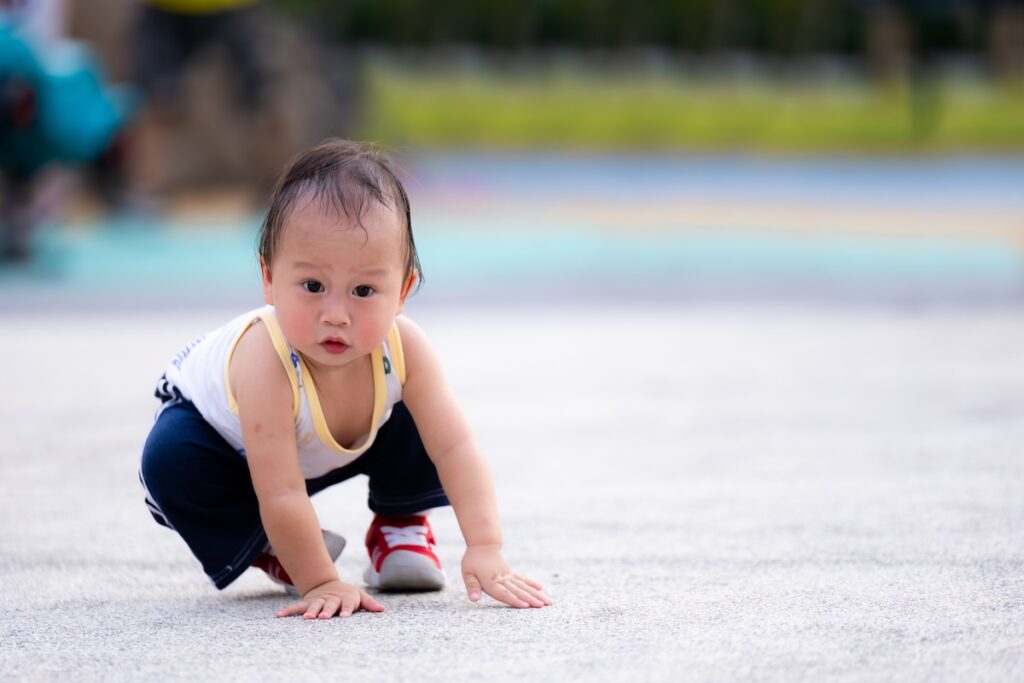
A few weeks ago, I started working with a 17-month-old who was not yet walking.
That was concerning on its own. But something else caught my attention even more quickly:
He used his right leg much more than his left.
When he crawled on his hands and knees, his right knee came farther forward. When he pulled to stand, he always led with his right foot. When he pushed a toy walker, his right leg did most of the work.
His parents hadn’t noticed it before.
That’s very common.
Most parents aren’t watching their baby’s movements with the same level of detail a pediatric physical therapist does. And honestly, you shouldn’t have to. But sometimes small movement patterns can tell us important things.
Here’s What Was Going On
Young babies and toddlers should move fairly symmetrically.
Before age 3, most kids should:
- reach with either hand
- crawl with equal effort on each side
- pull to stand with either leg forward
- walk up stairs leading with either foot
- explore movement in a balanced way
It’s normal for preferences to slowly emerge later.
But when a younger baby strongly favors one side, it’s worth paying attention.
In this case, I noticed a click in the baby’s left hip during my examination. That can sometimes be associated with hip dysplasia, so I referred him back to his pediatrician for further evaluation.
Hip dysplasia is a condition where the hip joint does not develop normally. Some babies with hip dysplasia may avoid using one leg because it feels unstable, stiff, or uncomfortable.
Whether or not that ends up being the cause, one thing was clear:
His movement was becoming increasingly one-sided.
Why It Can Be Hard to Change a Movement Pattern
This baby was extremely good at pulling to stand.
He moved quickly and efficiently using his right leg. Any attempt to encourage the left side caused immediate resistance.
That makes sense when you think about it from the baby’s perspective.
Imagine someone trying to make you do something in a slower, harder way when you already know an easier method. Just like you and me, babies prefer the movement pattern that feels strongest and most familiar.
The Unexpected Solution: Stairs
At home, the family had a staircase with a baby gate across it. The baby was excited to explore stairs for the first time. As he climbed, he naturally led with his right leg; his left mostly followed behind.
So on the next step, I gently shifted his weight to the right and encouraged him to lead with the left leg instead.
He resisted briefly, then figured it out. We practiced a few more steps before his mom took over.
That was it.
No complicated exercises.
No battles.
No forcing repetitions for thirty minutes.
Just a new skill that created a new opportunity.
Why New Skills Work Better Than Correction
Two weeks later, his mom proudly showed me how well he could climb the stairs. But something else had changed too.
He was now voluntarily lead with his left leg when pulling to stand.
Instead of constantly fighting his old movement pattern, we had introduced a brand-new activity where he had not yet developed a strong habit.
That gave us room to guide the movement the way we wanted it. Since he didn’t have experience with this activity, he didn’t have a preference of how it should be done.
This allowed us to work on strengthening his weaker side which lead to him to get more comfortable using his left leg in all his movement.
Sometimes the best path forward is not pushing harder through the old pattern.
Sometimes it’s finding a different activity that helps the body practice the missing skill in a more natural way.
What Parents Can Watch For
If your baby consistently:
- uses one hand or leg more than the other
- prefers looking or feeding in one direction
- crawls unevenly
…it may be worth discussing with your pediatrician or pediatric physical therapist.
It does not automatically mean something is wrong.
But asymmetry can sometimes give us early clues that a baby may need additional support.
One Simple Idea You Can Try
If your baby resists using one side, try introducing the skill in a completely different context.
New activities often create more flexibility and curiosity than correcting an old pattern directly.
That might look like:
- climbing cushions
- crawling over obstacles
- creeping up stairs with supervision
- reaching in different directions during play
Sometimes the key to unlocking your child’s potential is by introducing a new skill.
FAQ: Is It Normal for a Baby to Favor One Side?
Small differences can occur, especially during periods of rapid development.
But strong or consistent one-sided movement in babies and young toddlers is worth paying attention to, particularly if it affects feeding, crawling, standing, cruising, or walking.
If you are concerned, be sure to ask your child’s pediatrician. The pediatrician or a pediatric physical therapist can help determine whether it needs closer attention.
Want More Help Like This?
If you found this helpful, I write a short, weekly newsletter for parents who want to better understand their baby’s development—without overwhelm or alarm.
Each week, I share:
- Simple ways to support your baby’s movement
- Real stories from my work as a pediatric PT
- Practical ideas you can use right away
You can sign up here (and receive the first chapter of my book):

Dr. Trevor E. Carlson, PT, DPT
Pediatric physical therapist, author of Tummy Time to Walking, and founder of InfantPT.com.
I help parents better understand their baby’s movement and development with practical, calm, experience-based guidance.