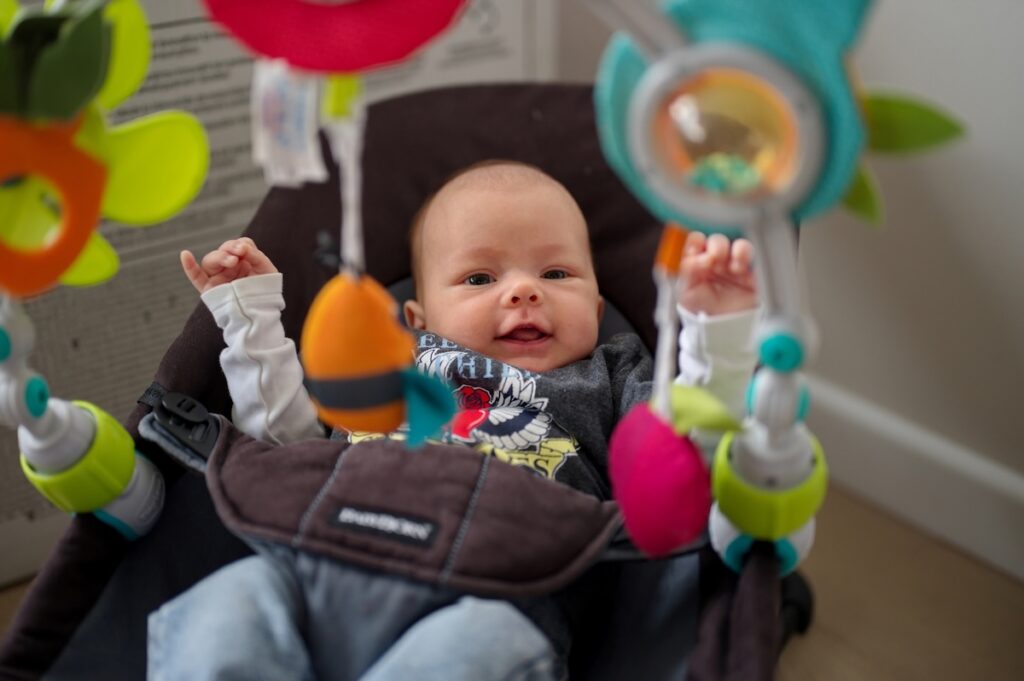
Let’s talk about containers.
A “container” is anything that holds your baby in place. That includes car seats, baby carriers, strollers, infant seats, bouncers, sit-in walkers, swings, high chairs, and play standers.
Containers are not bad. They can keep your baby safe. They can give you a few minutes to take a shower, make food, help another child, or simply breathe.
The problem comes when babies spend too much of their day in containers and not enough time moving freely.
Here’s what’s going on: babies learn to move by moving.
When a baby spends too much time held in one position, it can limit the little movements that build strength, coordination, head control, rolling, reaching, and crawling. Over time, too much container time can contribute to what is sometimes called Container Baby Syndrome.
A question I heard from parents this week
Yesterday, a family asked me about a play stander they had just bought for their baby.
It had toys attached to it and gave their baby a safe place to play for short periods of time. Their baby had recently started rolling and moving across the room. The parents were excited about this, but it also had them a little concerned. If one parent was home alone and needed to take a shower or prepare a meal, they needed somewhere safe to put the baby.
They were worried that even these short times in a container might harm their baby’s development.
I told this specific family not to worry.
Why?
Because they were coming at it with the right mindset.
They were not using the play stander as the baby’s main place to spend the day. They were using it as a helpful tool for short periods when they needed the baby to be safe and contained. Their baby was also getting lots of time to move freely, including at least 60 to 90 minutes of tummy time spread throughout the day.
Containers are useful tools. They become a problem when they become the default.
What is Container Baby Syndrome?
Container Baby Syndrome is a phrase used to describe movement and development problems that can happen when a baby spends too much time in devices that restrict movement.
This does not mean one stroller ride, one stretch in a carrier, or a few minutes in a play stander will harm your baby.
It also does not mean you should feel guilty for using baby gear. My wife and I used containers for short periods of time with our girls.
However, when babies spend a lot of time in containers, they are at greater risk for:
- Delays in movement development
- A flat or misshapen head
- Tightness in the neck
- Trouble turning the head equally both ways
- Favoring one side of the body
The reason is simple: containers reduce variety.
A baby in a car seat, swing, bouncer, infant seat, or play stander is being supported by the device. Their body does not have to make as many small adjustments. Their head may rest in one position. Their arms and legs may have less freedom. Their trunk does not have to work as much.
Babies need chances to use their bodies in lots of different ways.
Containers should be the exception, not the home base
One of the easiest traps with baby gear is that it becomes the default place to put the baby.
The baby goes into the car seat. Then into the stroller. Then into the swing. Then into the bouncer. Then into the high chair. Then back into the car seat.
None of those things are wrong by themselves.
But when you add them up, a baby can go through a large part of the day without much freedom of movement.
The floor is one of the best places for your baby
For babies, the floor is the best “developmental gym.”
It does not need to be fancy. You do not need expensive toys. You do not need a perfect setup. Just a blanket on the floor.
On the floor, your baby can:
- Turn their head both directions
- Practice looking toward sounds and faces
- Kick their legs
- Bring hands to mouth
- Reach for toys
- Roll toward something interesting
- Push up during tummy time
- Shift weight from side to side
- Learn how their body works
These little movements matter.
They are the foundation for bigger skills later, like sitting, crawling, pulling to stand, cruising, and walking.
A simple way to think about container time
You do not need to track every minute.
Instead, think about the pattern.
Are containers helping you get through real-life moments?
Or are containers where your baby spends most of the day?
That distinction matters.
A few minutes in a play stander while you shower is very different from a baby spending most of the day moving from one device to another.
A walk with a stroller is different from using a stroller as the main place your baby hangs out.
A baby carrier can be wonderful for closeness and connection, but your baby still needs time outside the carrier to move freely.
The goal is not to eliminate every container.
The goal is to make sure your baby gets many chances each day to move without being held in one position.
What about car seats?
Car seats are necessary for safe travel. Use them every time your baby is in the car.
The concern is not normal car seat use during travel. The concern is when the car seat becomes a place where the baby spends lots of extra time outside the car.
This is especially easy to overdo with car seats that are designed to hold a baby outside of the car. When it is easy to unsnap the car seat and carry the baby to another location, it becomes easy to give that baby too much time in their container.
What if my baby hates tummy time?
This is one reason container time can sneak up on families.
If your baby does not like tummy time, it is very easy to avoid it. Then the baby spends more time on their back or in containers. Then tummy time stays hard because they are not getting enough practice.
You do not have to force long stretches of tummy time.
Start small.
It’s okay if your baby only tolerates 30 seconds (or less) at a time. Just consistently give them 30 seconds at a time and increase the number of times on their tummy each day. With this consistently they will build the strength they need to work up to the 60-90 minutes of tummy time they need.
Signs your baby may need more free movement
You may want to look more closely at container time if your baby:
- Is not rolling, reaching, or moving as much as expected
- Spends much of the day in seats, swings, carriers, strollers, standers, or other devices
These signs do not automatically mean something is seriously wrong. But they are worth paying attention to.
Often, the first step is simply more floor time, more position changes, and more opportunities to move.
Practical takeaway
Use containers when they help with safety, travel, meals, connection, or your own sanity.
But try not to let containers become your baby’s main place to spend the day.
A helpful rhythm is:
Container when needed. Floor when possible. Held when wanted. Variety throughout the day.
Your baby does not need a perfect routine. Your baby needs chances to move, explore, and use their body in different ways every day.
FAQ
Will short periods in a baby container hurt my baby’s development?
Short periods in a container are usually not a problem if your baby is also getting lots of time to move freely. The concern is when containers become the main place your baby spends the day.

Dr. Trevor E. Carlson, PT, DPT
Pediatric physical therapist, author of Tummy Time to Walking, and founder of InfantPT.com.
I help parents better understand their baby’s movement and development with practical, calm, experience-based guidance.