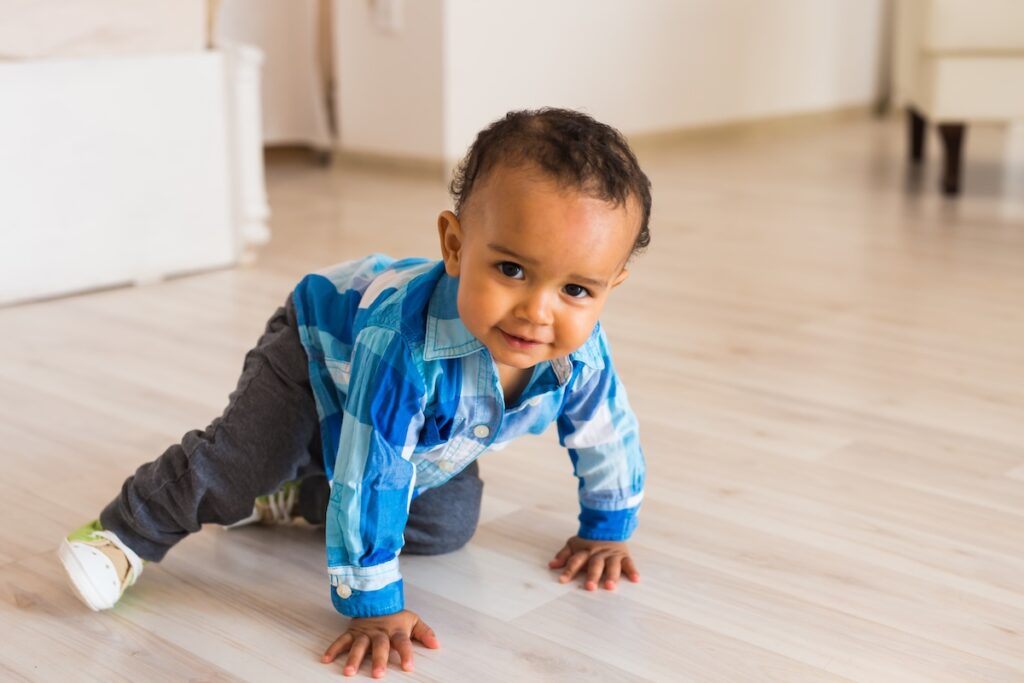
I recently evaluated a baby in my physical therapy practice who had just started moving forward on his hands and knees—but not in the way most people expect.
He would get into the hands-and-knees position, but instead of moving one arm and the opposite knee forward, he slid both knees forward at the same time.
At first glance, it looked unusual. But it also told me something important:
He wanted to move.
That matters more than many parents realize.
Curiosity, exploration, and the desire to move independently are all positive developmental signs. Before worrying about how a baby moves, I first look at whether they are motivated to explore their environment.
In this case, he absolutely was.
So the question became:
Should we change the movement pattern?
Here’s What’s Going On
Some babies discover creative ways to move that are different from the classic crawling or creeping pattern.
(Technically, physical therapists often use the word creeping to describe moving on hands and knees with alternating arms and legs, but most parents simply call this crawling.)
This baby had figured out that sliding both knees forward worked well enough to get where he wanted to go.
The good news was that he had already mastered the difficult parts:
- He could get into and maintain the hands-and-knees position
- He had enough core strength to support himself
- He was motivated to move and explore
Those are big developmental wins.
Now we just needed to help him refine the mechanics.
Why Crawling Patterns Matter
When babies crawl by moving one arm with the opposite leg, they are practicing an important coordination pattern called reciprocal movement.
This pattern becomes foundational for later skills involving coordination between the two sides of the body.
I’ve evaluated older children who skipped crawling entirely and later struggled with movements like jumping jacks, skipping, or other coordinated activities in school.
That doesn’t mean every baby who crawls differently will have future coordination problems. Development is never that simple.
But when we can gently encourage a more efficient movement pattern early, it often helps support future coordination and strength.
The Core Strength Piece
There’s another reason I wanted to help this baby shift away from sliding both knees together.
That movement pattern relied heavily on the rectus abdominis—the “six-pack” muscles many adults think of as the core.
But true core strength is much broader than that.
The core includes many smaller stabilizing muscles around the spine and pelvis, including the obliques and multifidi muscles. These muscles help babies stabilize and rotate their bodies during movement.
Alternating arm-and-leg crawling naturally strengthens those stabilizers because the body has to shift weight from side to side while maintaining balance.
Sliding both knees forward at once reduces some of that challenge.
As I discuss in Tummy Time to Walking, babies build the best strength through normal movement and exploration—not through isolated exercises.
Before Helping a Baby Move Differently, I Change the Environment
One thing I’ve learned as a pediatric physical therapist is this:
Often the easiest way to change a movement pattern is to change the environment.
Before I place my hands on a baby or try to physically guide a movement, I first ask:
“What in the environment is encouraging this pattern?”
In this case, the answer was simple.
The baby was on a slick floor.
Hardwood, tile, and linoleum create very little resistance. Sliding both knees forward becomes an efficient solution.
Babies are smart.
Why lift one knee at a time if sliding works just fine?
Try a Rug or Carpet First
Sometimes simply placing a baby on a rug or carpet changes the movement pattern immediately.
The extra resistance makes sliding both knees together harder, which encourages lifting one knee at a time.
Sometimes babies will instantly switch to a more typical crawling pattern.
Other times, they stop moving forward altogether because the new surface suddenly feels much harder.
That’s okay too.
If that happens, let your baby continue exploring in the way they currently can. Then gradually reintroduce the rug or carpet during play.
Often they figure it out naturally over time.
The Blanket Trick That Helped This Baby
For the little guy I evaluated, the rug alone wasn’t enough.
So his mother and I tried something simple.
We placed a blanket in front of him and scrunched it slightly so it created small ripples and bumps.
When he moved toward a toy he wanted, he suddenly needed to lift one knee high enough to get over the edge of the blanket.
That tiny environmental change encouraged the exact movement pattern we wanted.
The first few times, we helped hold the blanket down so it wouldn’t slide or bunch up too much. He wasn’t lifting his knees very high yet, and we wanted him to succeed instead of getting frustrated.
Within a short time, he started bringing one knee forward more naturally.
One of the Best Parenting Tools: Changing the Environment
I always enjoy moments like this because they remind me of something important:
Sometimes the best way to help a baby learn is not by constantly correcting them, but by changing the environment around them.
When the environment supports the skill, babies can practice more independently without an adult constantly stepping in.
And honestly, parenting already involves enough moments where you have to say “no” or become the obstacle to what your baby wants.
It’s nice when the environment can do some of the teaching instead.
Practical Takeaways
If your baby crawls by sliding both knees forward:
- First, celebrate that they are motivated to move and explore
- Try practicing on carpet or a rug instead of slick flooring
- Use small obstacles like a scrunched blanket to encourage lifting one knee at a time
- Keep practice playful and frustration low
- Remember that movement variation is common, especially early in learning new skills
Most importantly, remember that babies are trying to solve movement problems the best way they can with the environment they are in. Sometimes a small change to that environment is all it takes to help a new skill emerge naturally.
FAQ
Is it bad if my baby crawls differently?
Not necessarily. Many babies experiment with unusual movement patterns while learning mobility skills. What matters most is whether your baby is continuing to explore, gain strength, and develop new movement abilities over time. However, if your baby continues to use different movement pattern, please discuss it with the pediatrician or pediatric physical therapist.

Dr. Trevor E. Carlson, PT, DPT
Pediatric physical therapist, author of Tummy Time to Walking, and founder of InfantPT.com.
I help parents better understand their baby’s movement and development with practical, calm, experience-based guidance.