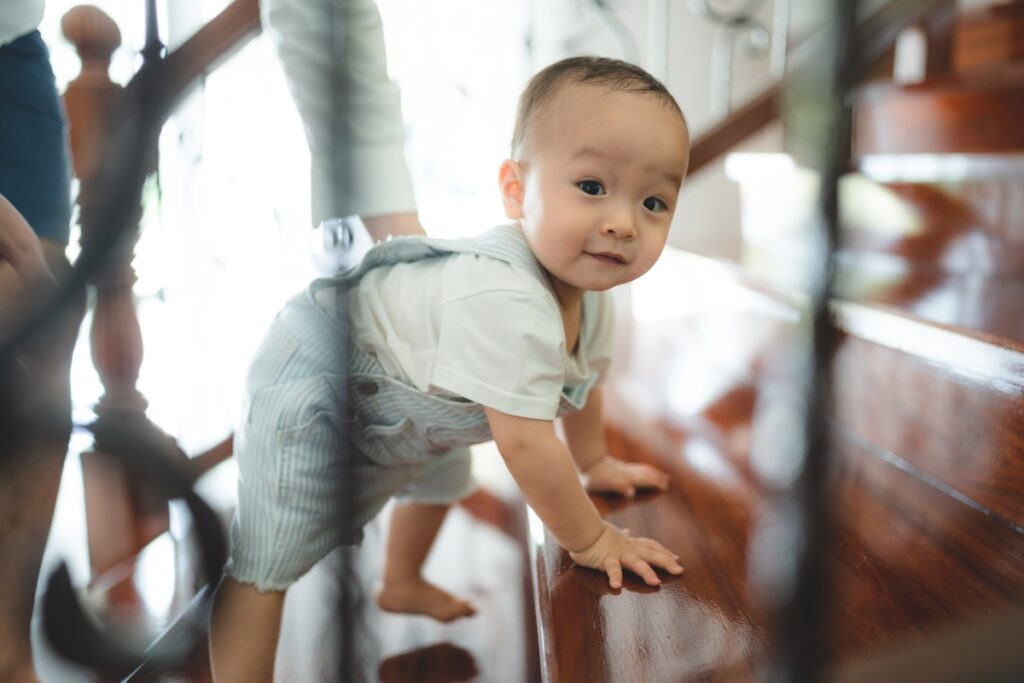
A dad joked with me recently that his son was “a head first kid.”
It was a pretty accurate description. This little boy was fearless, fast-moving, and completely uninterested in caution. He had started crawling down stairs and launching himself off couches head first. No hesitation. No reverse gear.
Unfortunately, babies who always go head first usually discover gravity the hard way.
Helping a baby learn to climb down backward is not just about preventing falls. It is actually an important developmental skill that teaches the brain how to move safely without relying entirely on vision.
Here’s what’s going on.
Why Babies Prefer Going Head First
We are visual creatures. We naturally want to see where we are going.
That is why many babies try to crawl forward off a couch or down a stair. They can see the floor in front of them, but they cannot yet trust the information coming from the rest of their body.
Going down backward requires something different.
Your baby has to:
- Feel where their hands and knees are
- Shift weight without seeing the landing spot
- Coordinate movement using body awareness instead of vision
This ability is called proprioception.
Proprioception is the brain’s ability to sense where the body is in space through information coming from muscles and joints. It is one of the hidden foundations of coordinated movement.
A Simple Example: Learning to Type
My 12-year-old daughter wants to learn how to touch type.
Right now, she still looks down at her fingers while typing. That is normal. Vision is helping guide the movement.
To improve, she recently started covering her hands with a piece of paper while practicing. Without seeing her fingers, her brain has to rely more on feel and repetition.
That process is very similar to what babies experience when learning to climb down backward.
They are learning to trust what their body feels, not just what their eyes can see.
How to Teach Your Baby to Get Down Safely
The best way to teach this skill is through repeated practice with your help.
If your baby is trying to get off the couch or approach stairs head first, gently turn them around and guide them through the movement backward. Put your hands on them as little as possible so that they feel only what is necessary for their movement.
Give them lots of practice. The simply need lots of repetition.
Over time, your baby’s brain starts recognizing:
- where their legs are
- how far they are from the floor
- how to shift weight safely
- how to coordinate movement without using their eyes.
Eventually, your baby will automatically turn around feet first before climbing down.
That is a huge developmental win.
What This Skill Builds Beyond Safety
Learning to descend backward helps build:
- body awareness
- coordination
- motor planning
- balance
- confidence with movement
It also helps babies become more adaptable movers instead of relying only on visual input.
This matters later for:
- climbing playground equipment
- navigating uneven surfaces
- sports and physical play
- general coordination and confidence
Sometimes a simple everyday movement teaches much bigger developmental lessons.
What If My Baby Refuses to Go Backward?
Some babies resist this skill for a while, especially adventurous ones.
That is normal.
Many babies need lots of guided repetition before they independently turn around to climb down. The key is staying calm and consistent.
Instead of repeatedly saying “No!” when your baby goes head first, focus on physically helping them experience the safer movement pattern again and again.
The brain learns through doing.
FAQ
When should babies learn to climb down backward?
Many babies begin learning this skill sometime during the crawling stage, especially once they start exploring furniture, stairs, or playground structures. The timing varies, but repeated practice and supervision help the skill develop naturally.
One Chapter That Never Made the Book
In the first draft of Tummy Time to Walking, I actually included an entire chapter on helping babies climb up and down couches, stairs, and household obstacles.
My editor encouraged me to cut it to keep the book shorter.
I still think the topic matters.
If enough parents are interested, I may dig up that rough draft, clean it up, and turn it into a future blog post. If you’re interested, email me and let me know. I may not reply quickly, but I read every email.

Dr. Trevor E. Carlson, PT, DPT
Pediatric physical therapist, author of Tummy Time to Walking, and founder of InfantPT.com.
I help parents better understand their baby’s movement and development with practical, calm, experience-based guidance.